
You may have heard of the term Enterprise Architecture, or “EA”, and wondered what it was? You may deal with Enterprise Architects in your company and still not quite understand what EA is. You may even have been burnt by a failed EA initiative(s) and thought, is this really what EA is?
Well, my objective in this blog is to help you to answer the question, what is EA. For clarity, my intent here is to define EA, the “what”, not the “why” or the “how”. Those are significant discussions in their own right and depend on your definition of EA, which is my task here.
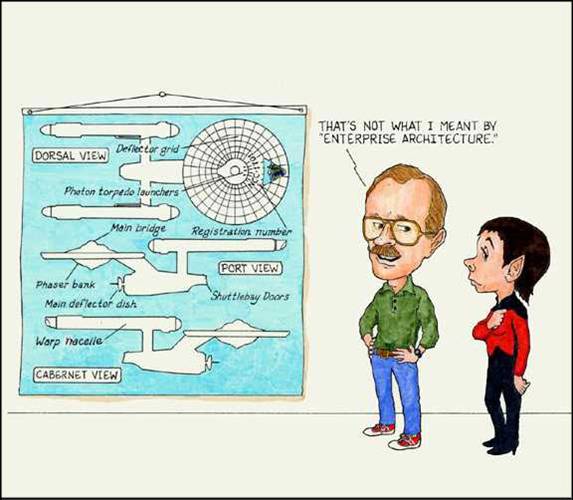
Source: [6]
If you are business person (not from Information Technology (IT)). I urge you to keep reading to see that EA is not just an IT thing, instead it should be a whole of business thing. Business people are a critical part of EA.
If you are from IT you are probably aware of EA, and/or may see EA as an IT only capability. Even only something for the “ivory tower” IT architects, not applicable to you. I urge you to keep reading to also understand that EA is not just an IT capability or isolated architecture thing. All of IT should be involved with, and be directly influenced by, EA.
Some background and history first…
EA is a relatively new field, originating in 1987 by John Zachman in his seminal article for IBM Systems Journal[1]. So it is still very much maturing and evolving as a field, today there are a number of differing approaches and processes defining how EA is done. You may have heard of TOGAF, FEA, Zachman or Gartner EA frameworks, these are the four major frameworks and are all quite different. However each have similar goals, and as such is one reason you will find multiple definitions of EA.
Zachman’s seminal article, back in 1987, on EA was as a response to two main concerns:
- the growing complexity of IT
With increasing size and complexity of the implementations of information systems, it is necessary to use some logical construct (or architecture) for defining and controlling the interfaces and the integration of all of the components of the system.[1]
- the growing dependency of business success on IT
The cost involved and the success of the business depending increasingly on its information systems require a disciplined approach to the management of those systems.[1]
These two concerns came out of IT, IT becoming more complex and becoming more critical to business. This is an important point for the history of EA and the definitions of EA as it explains why EA has been primarily performed by IT and within IT in the past.
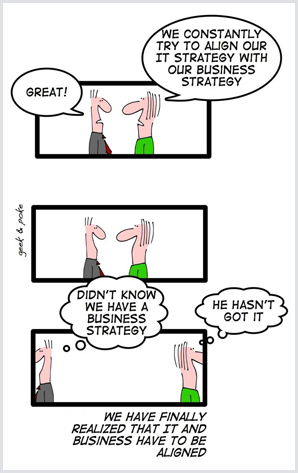
Source: [7]
In 2006 the book “Enterprise Architecture as Strategy”[2] detailed this problem and a solution, a quote sums it up.
Enterprise Architecture is not an IT issue – it is a business issue [2]
This shift in focus has lead to even more definitions of EA.
My simple description of Enterprise Architecture…
the essence of EA is about achieving business change and value, leveraging technology.
This is clearly simplistic for a complex domain however I believe this captures the essence of what EA is today. Why “leveraging technology”? Well strictly speaking EA does not require technology to achieve the objective of business value. However EA originated out of IT and solving IT/Technology concerns and as such is more directed at technology based business change.
A more complete definition of EA…
Here I am going to use two industry definitions of EA that define EA well, and I will explain why. As there are many definitions of EA, I will end this discussion with links to other EA definitions, that you can review for yourself.
Here are the definitions that define EA well:
- Federation of Enterprise Architecture Professional Organisations (FEAPO)
Enterprise architecture (EA) is “a well-defined practice for conducting enterprise analysis, design, planning, and implementation, using a holistic approach at all times, for the successful development and execution of strategy. Enterprise architecture applies architecture principles and practices to guide organizations through the business, information, process, and technology changes necessary to execute their strategies. These practices utilize the various aspects of an enterprise to identify, motivate, and achieve these changes.”[3]
- Gartner [4]
Enterprise architecture (EA) is a discipline for proactively and holistically leading enterprise responses to disruptive forces by identifying and analyzing the execution of change toward desired business vision and outcomes. EA delivers value by presenting business and IT leaders with signature-ready recommendations for adjusting policies and projects to achieve target business outcomes that capitalize on relevant business disruptions. EA is used to steer decision making toward the evolution of the future state architecture.[4]
Why are these good definitions of EA? Because they both talk to the focus “EA is not an IT issue, it is a Bussiness issue”[2]. These definitions talk about:
- the outcome of EA being driven by, or executing to, the business strategy and vision. EA is about outcomes or value for the business
- EA guiding, leading or steering the business towards the business outcomes. EA is a journey not a destination.
- change in both business (people, process…) and IT. EA is not just about Technology.
- EA being “wholistic” not just about defining a technology target state, it is about analysis, design, planning and execution of the business strategy from both business and IT, the result should be actual business change providing business outcomes and value.EA is a whole of business approach.
Other definitions of EA…
There are many more definitions of EA, here is a summary of ten definitions[5] that you can further review.
EA is still an evolving field, however, I hope this has helped define for you “what” EA is. “why do EA” is the subject of a following discussion.
Footnotes:
- [1] John A. Zachman (1987). “A Framework for Information Systems Architecture”. In: IBM Systems Journal, vol. 26, no. 3, 1987. IBM
- [2] Jeanne W. Ross, Peter Weill, David C. Robertson (2006). “Enterprise Architecture as Strategy: Creating a Foundation for Business Execution”. Harvard Business Press.
- [3] FEAPO (6 Nov, 2013). Common Perspectives on Enterprise Architecture,” Architecture and Governance(PDF). Http://feapo.org. Accessed: 25 Oct, 2014.
- [4] Gartner (2014). Gartner EA Definition(web). http://www.gartner.com/it-glossary/enterprise-architecture-ea/. Accessed: 25 Oct, 2014.
- [5] Konstantin Ivanovo (2009). Ten Definitions of Enterprise Archirecture(Web). http://www.ariscommunity.com. Accessed: 25 Oct, 2014.
- [6] The copyright owner of this image is unknown. Please contact me if you are the copyright owner and I will add reference. Taken from: http://www.enterprise-advocate.com/2012/02/enterprise-architecture-jokes, Accessed on 25/10/14.
- [7] Oliver Widder, http://geek-and-poke.com/ http://geek-and-poke.com/, Accessed on 25/10/14.
 richard malcolm